
Uzbekistan

Uzbekistan travel guide: Everything you need to know before visiting Uzbekistan
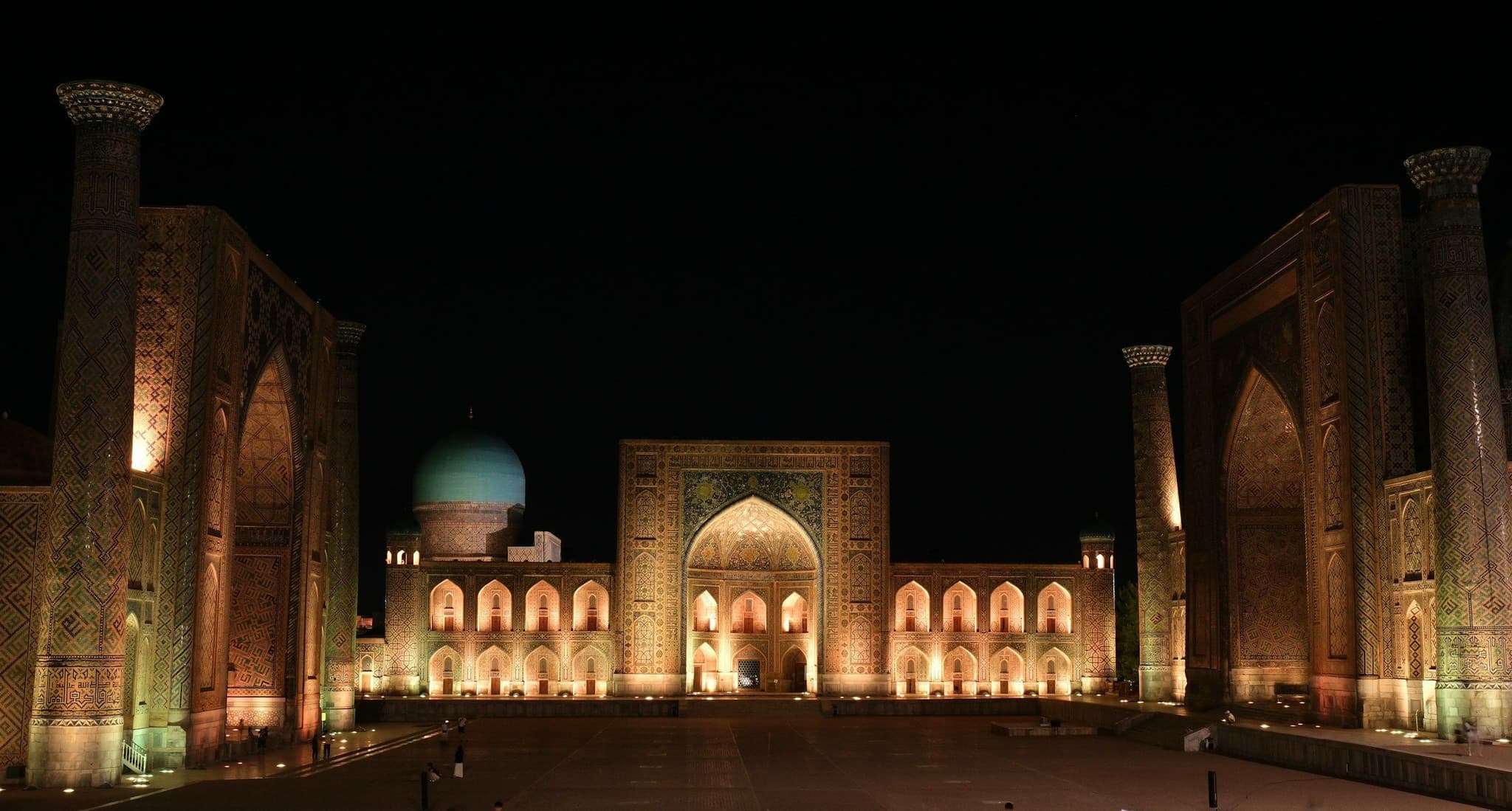
Three madrasas face one another across the Registan in Samarkand. The first went up between 1417 and 1420, the last was finished in 1660, and we'd say that square alone justifies the flight. Uzbekistan has eight UNESCO World Heritage sites, and the old Silk Road cities sit along one railway, so a morning among tiled domes in one city can end with dinner in the next.
What sets it apart from its neighbours is that the history here is in buildings, not landscapes. Kyrgyzstan is the country for mountains and yurts, and Kazakhstan for steppe and new cities, while Uzbekistan is settled, urban Central Asia, with madrasas and bazaars at the centre of every town. It suits first-timers to the region and anyone who plans a trip around architecture or food. It suits summer heat-avoiders less, with July highs of 35 to 37 °C, and trekkers will be happier in Kyrgyzstan. In this Uzbekistan travel guide we'll take you through the best places to visit, itinerary ideas, costs and practical tips for planning your trip.
5 reasons to visit Uzbekistan
Why now? Getting in and getting around have both become easier over the past year, and these are the five things we'd build a first trip on.
- Stand in Samarkand's Registan, where three madrasas built between 1417 and 1660 face one square.
- Ride the Afrosiyob, the Spanish-built Talgo train that takes you from Tashkent to Samarkand in two to two and a half hours.
- Sleep inside the walls of Khiva, a whole town with more than 50 monuments and about 250 old houses.
- Eat plov scooped from giant wood-fired kazans at Besh Qozon in Tashkent.
- See the world's second-largest collection of Russian avant-garde art at the Savitsky Museum in Nukus.
Where to visit in Uzbekistan?
Keep to the railway for your first trip. The line runs west from Tashkent to Samarkand, Bukhara and Khiva, and almost everything else on this list works as a side trip from one of those four. These are the 11 places we'd choose from.
Give Tashkent a full day instead of a layover
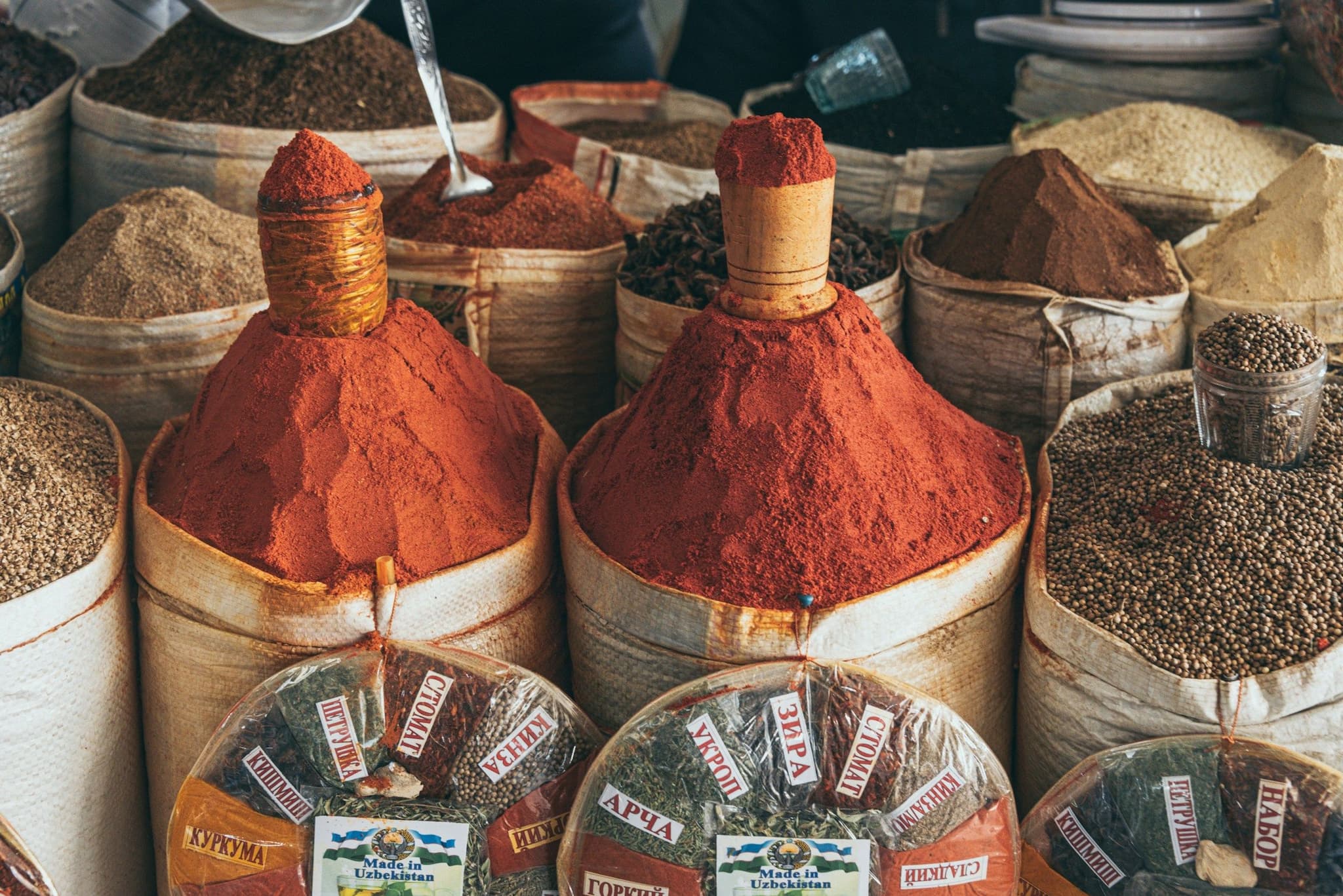
Tashkent is the largest city in Central Asia, with about 3.2 million people, and most itineraries rush straight through it. We wouldn't. The city was rebuilt after the 1966 earthquake, and in July 2026 UNESCO listed ten of its modernist buildings, among them the blue dome of Chorsu Bazaar and Kosmonavtlar metro station. The metro opened in 1977, the first in Central Asia. For the older city, head to the Hazrati Imam complex and its 16th-century Barak-Khan Madrasa. The 7th-century Uthman Quran is no longer kept there. It now sits next door, in the Center for Islamic Civilization, which opened in March 2026 under a 65-metre central dome.
Spend two full days in Samarkand
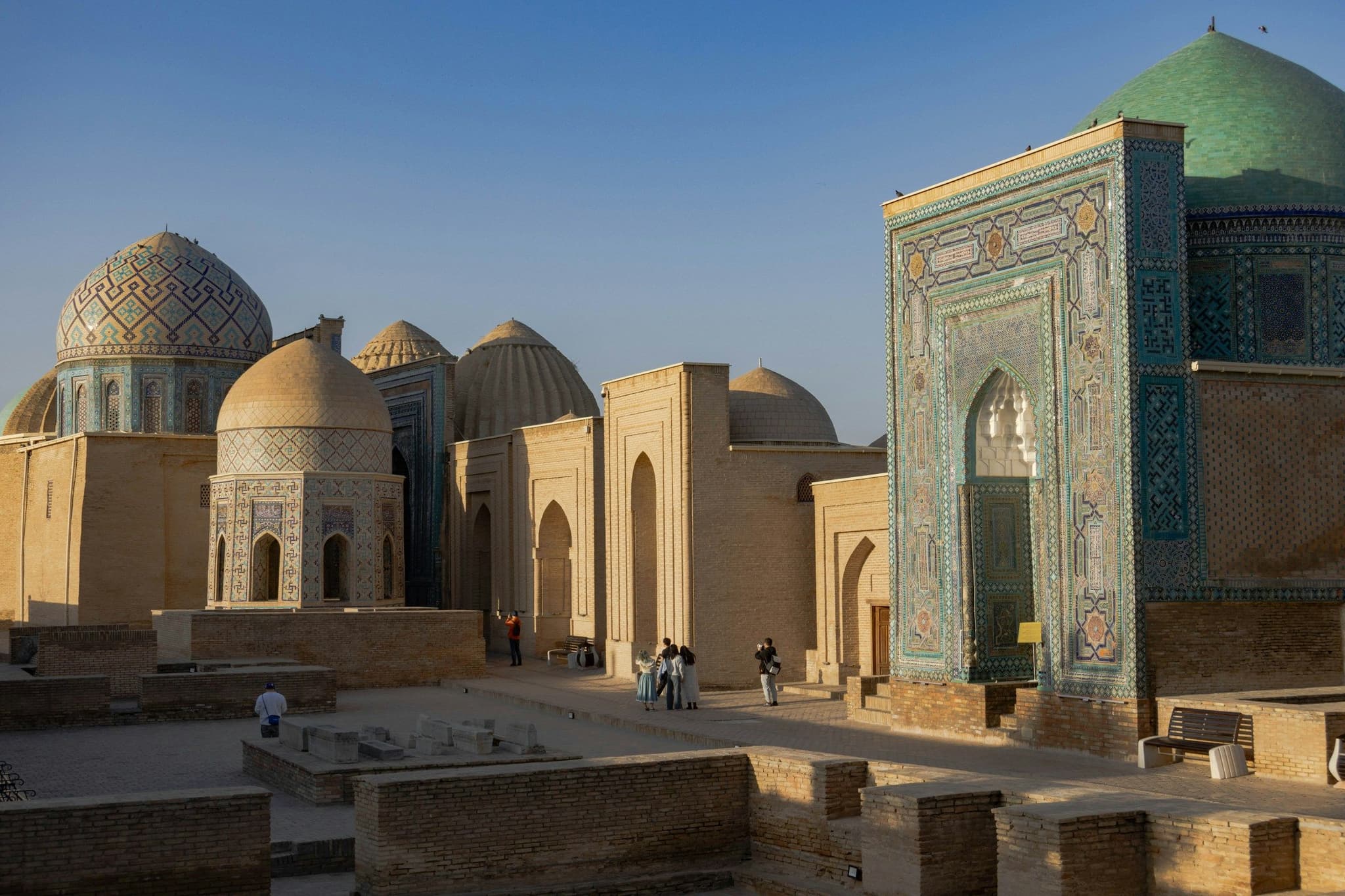
Samarkand marked 2,750 years in 2007, and its Timurid monuments are the heart of any trip here. The Registan costs 100,000 so'm. Timur lies in Gur-e-Amir under a dark green jade tombstone, with his grandson Ulugh Beg nearby. Our favourite spot is Shah-i-Zinda, a street of more than 20 tiled tombs built between the 11th and 19th centuries around a shrine said to belong to Qutham ibn Abbas, a cousin of the Prophet. Go when it opens. It beats the Registan at midday. Bibi-Khanym, the huge mosque Timur built from 1399, partly collapsed in an 1897 earthquake and is being restored again with the Aga Khan Trust for Culture, so expect scaffolding.
Slow down in Bukhara's old town
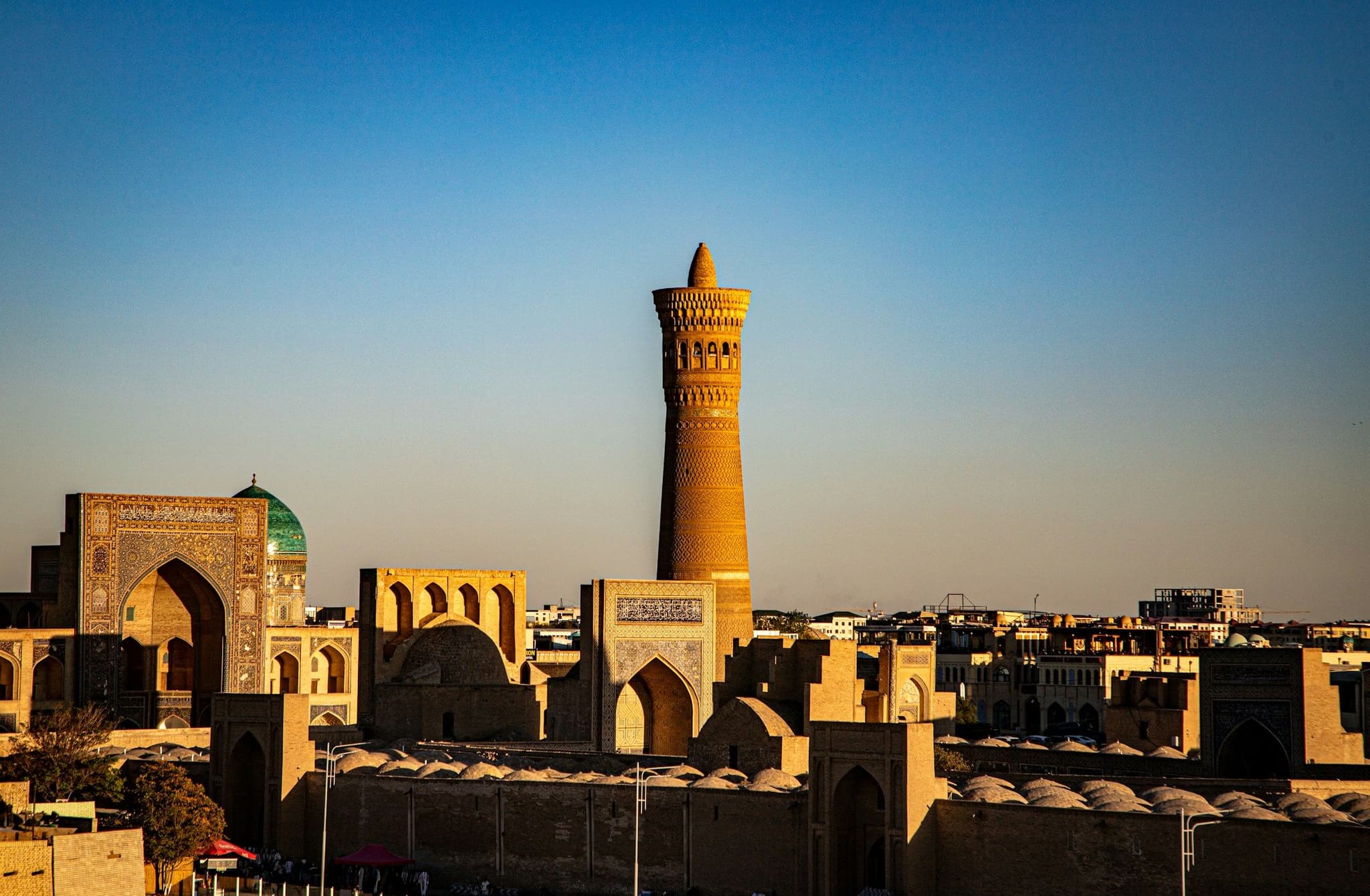
Which city deserves the most nights? Bukhara, and we'd give it three nights if your route has room. The Kalyan minaret has stood since 1127 at 45.6 metres, and legend says Genghis Khan was so struck by it that he spared it. Nearby, the Mir-i-Arab madrasa of 1535 still trains students. The 10th-century Samanid Mausoleum survived because silt had buried it before the Mongols arrived in 1220, and it's the oldest surviving Islamic monument in Central Asia. Evenings belong to Lyab-i Hauz, a pool dug around 1620 beside the Kukeldash Madrasa of 1568 to 1569, with a statue of Nasreddin Hodja on its edge. Walk the lanes between the 16th-century trading domes after dark.
Stay overnight inside Khiva's walls
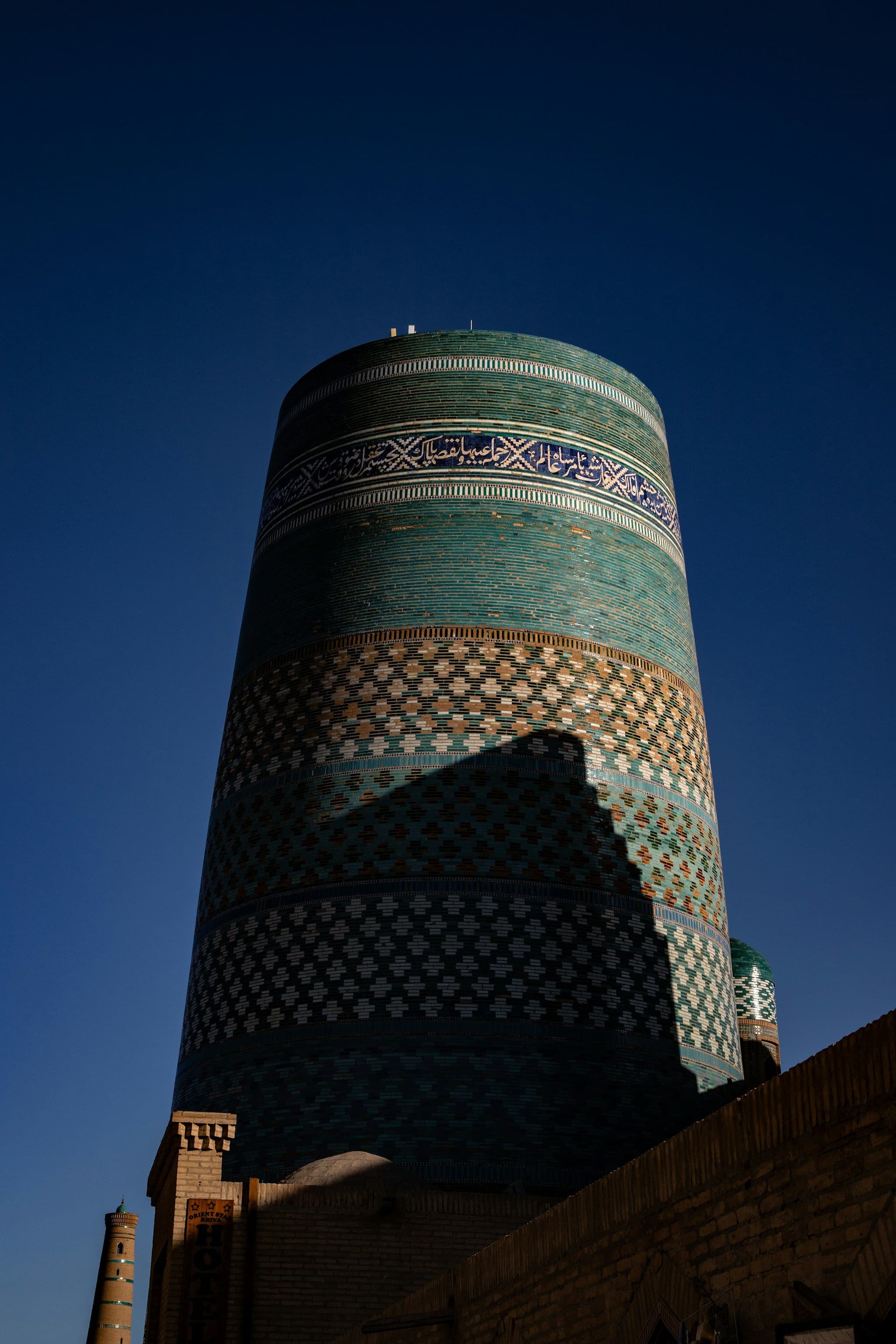
Itchan Kala, the walled inner town of Khiva, became Central Asia's first World Heritage site in 1990. Its walls rise 8 to 10 metres around more than 50 monuments and about 250 old houses, mostly from the 18th and 19th centuries. Kalta Minor is the stubby one in green and white tiles, left unfinished when Muhammad Amin Khan died in 1855. Islam Khoja, at 56.6 metres, is the tallest. Inside the Juma Mosque stand 213 carved wooden pillars, the oldest from the 10th century. Walking the streets is free, and a 250,000 so'm pass covers 17 museums for 48 hours. By day it can feel like an open-air museum, so stay the night.
See Timur's palace gate in Shakhrisabz
Shakhrisabz, the old town of Kesh, is where Timur was born, about 80 km south of Samarkand. What's left of his Ak-Saray palace, built from 1380 to 1404, is a pair of portal pylons 38 metres tall, and the scale of them is the reason to come. The Kok Gumbaz mosque of 1437 is nearby. Be ready for what's missing. UNESCO listed the town in 2000, then put it on its "in danger" list in 2016, after the medieval quarters between the monuments were bulldozed in 2015 to make a park. Come on a day trip from Samarkand for Ak-Saray alone.
Watch silk being made in the Fergana Valley
The Fergana Valley is Uzbekistan's crafts heartland, and its workshops beat any souvenir stall in Bukhara. The train from Tashkent to Kokand takes about four hours over the Kamchik pass. In Margilan, the Yodgorlik silk factory, founded in 1972, shows the whole process, from boiling cocoons to weaving ikat on hand looms. The Kumtepa bazaar runs on Sundays. Rishtan is the place for blue-glazed ceramics, and Kokand has the Khudayar Khan palace of the early 1870s, where 19 of the original 110-plus rooms survive. Hire a car with a driver to link the towns.
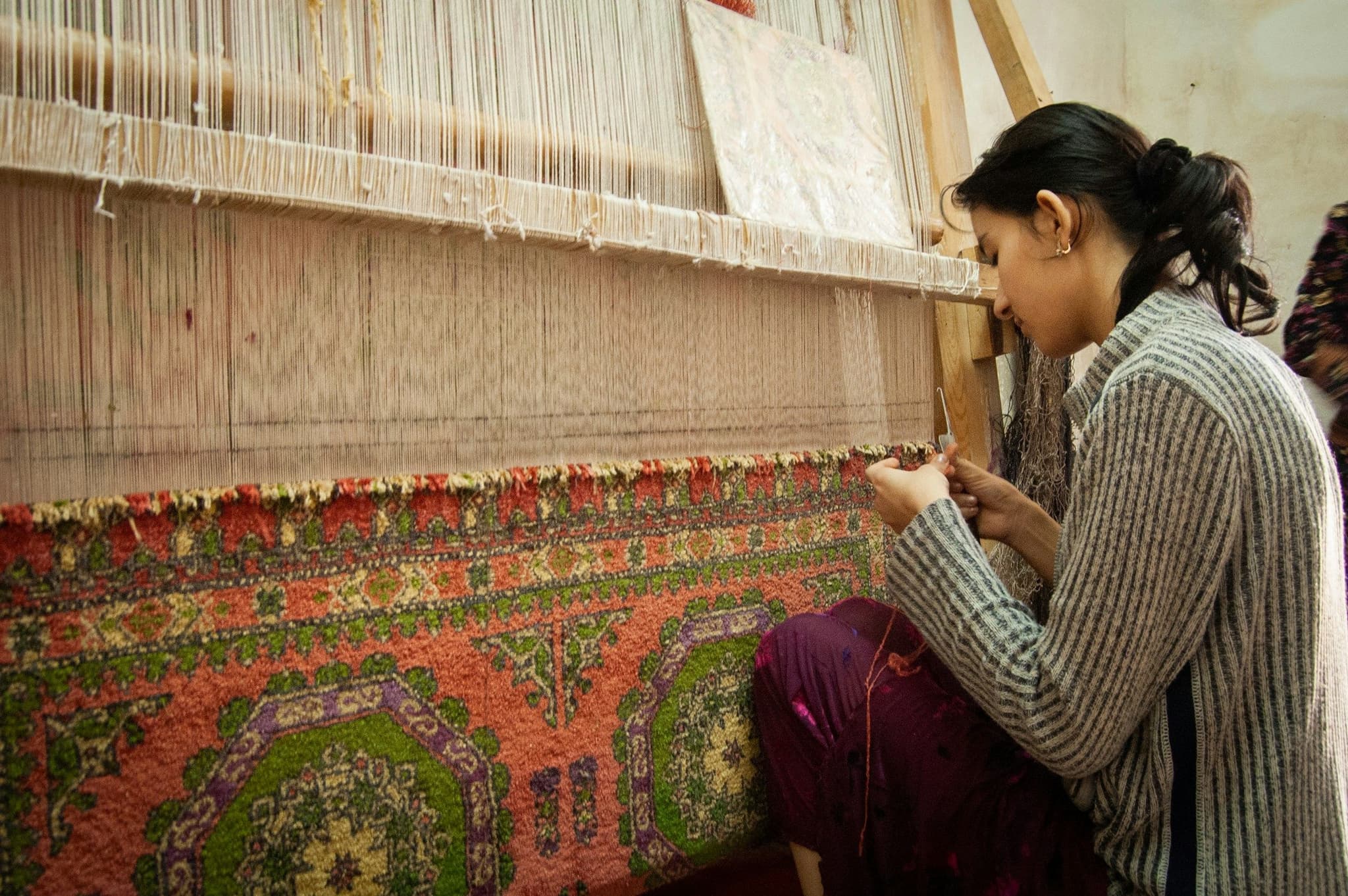
Visit the Savitsky Museum in Nukus
We think the Savitsky Museum is reason enough for the long trip west. Igor Savitsky founded it in 1966 in Nukus, the capital of Karakalpakstan, and gathered more than 82,000 items, including about 10,000 works of Russian avant-garde art. Only the Russian Museum in St Petersburg holds a larger collection of this work. It's often called the museum of forbidden art. It's about 16 hours from Tashkent by night train, or a domestic flight away, so pair it with Moynaq.
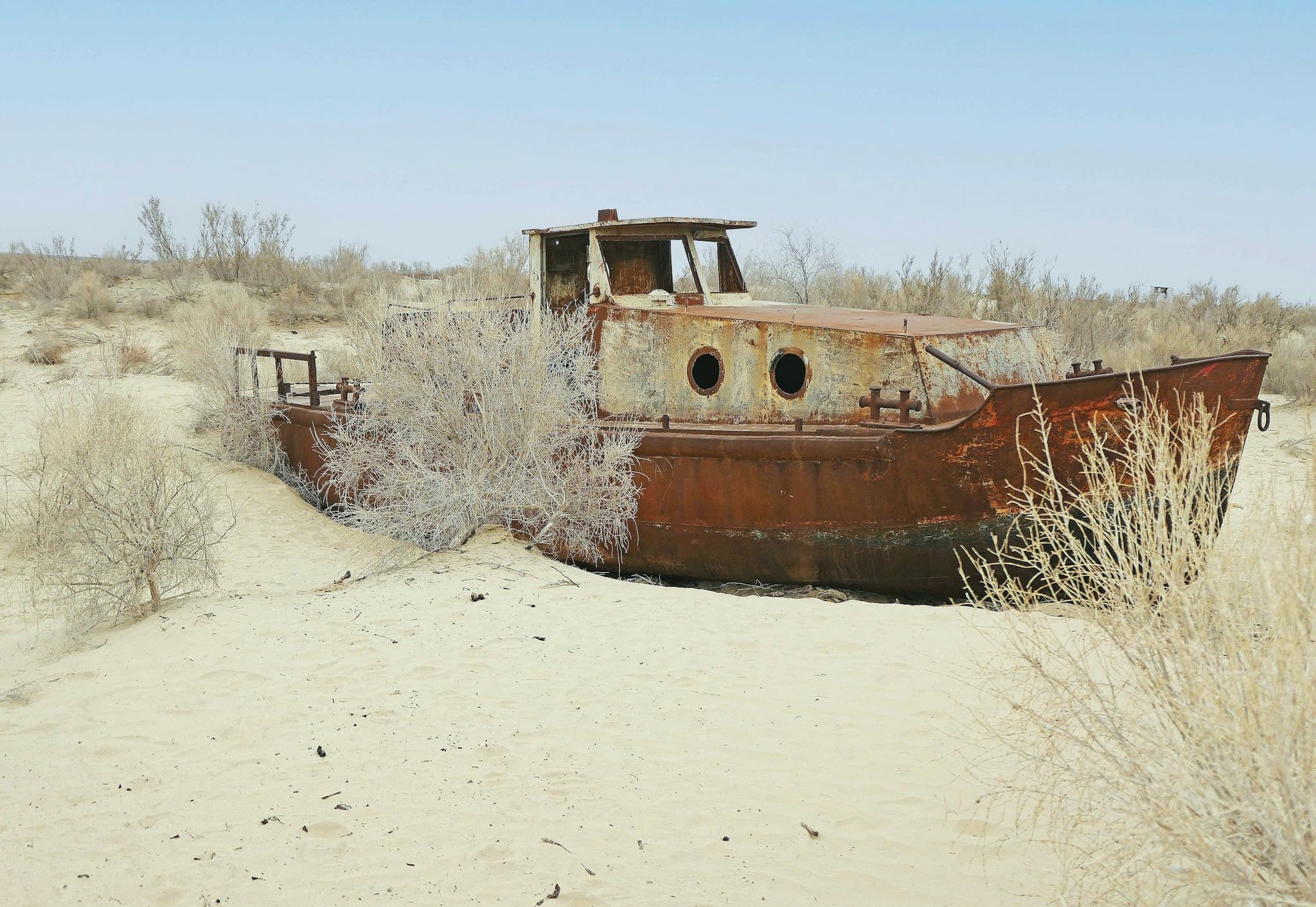
Walk among the stranded ships at Moynaq
In 1960 the Aral Sea covered about 68,000 km². Moynaq was a fishing port on its shore. By 1998 its area had shrunk by 60%, and by 2014 the eastern basin had dried out completely, leaving a new desert, the Aralkum. Moynaq now lies about 150 km from the water, and rusting ships sit on the old seabed outside the town, with a small Aral Sea museum nearby. The bus from Nukus takes about three hours. It's sobering rather than pretty, and we'd treat it as a day out from Nukus.
Explore the desert fortresses of ancient Khorezm
Mud-brick ruins in an empty desert, best at golden hour, and an easy half-day from Khiva. Ayaz Kala, about 70 km from Khiva, is three forts on a hill, the earliest from about the 4th century BC. Toprak Kala was a palace city of the 1st to 3rd centuries and the capital of Khorezm for part of that time. Sergei Tolstov's team began exploring it in 1938 and found Zoroastrian wall paintings. These sites are on UNESCO's Tentative List, added in September 2025, but they aren't World Heritage sites yet.
Spend a night in a yurt camp near Aydarkul
Is a desert yurt camp touristy? Yes, and we'd still stay a night between Samarkand and Bukhara. The camps sit near Nurata, about four hours from Bukhara, and the evening means a camel ride towards Aydarkul lake, then a campfire dinner with songs from an akyn, a folk singer. The lake only formed in 1969, from floodwater released by the Shardara dam. A three-hour camel ride costs about $30. The real draw is the silence after dark and a sky full of stars.
Escape to the mountains at Chimgan, Charvak and Amirsoy
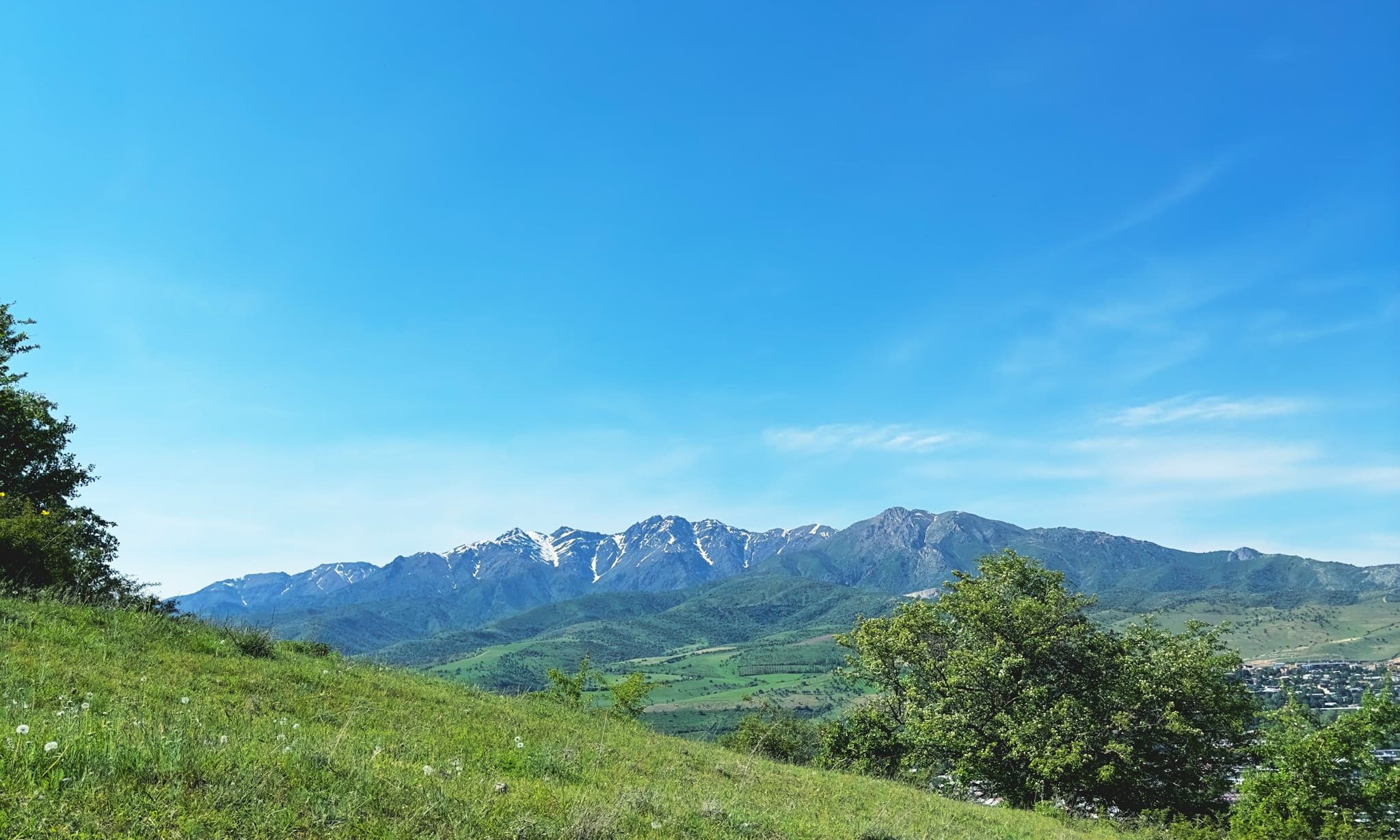
When the domes start to blur together, head into the hills east of Tashkent. Charvak reservoir sits behind a 168-metre dam finished in 1970, and its resort villages include Yusufhona, with paragliding on the shore, and Burchmulla. The Chimgan peaks above pass 3,300 metres. Amirsoy, about 98 km from Tashkent, is a modern resort with a Doppelmayr gondola rising from 1,630 to 2,290 metres and about 16 km of runs. Come for the lake in summer or the slopes in winter.
Uzbekistan itinerary ideas for your trip
The Afrosiyob takes about two to two and a half hours from Tashkent to Samarkand, and under two hours from Samarkand to Bukhara. Since May 2026 a high-speed train also runs on to Khiva, which takes about three and a half hours from Bukhara and about seven and a half from Tashkent. If you have to cut something from the 10 to 14 day route, we'd drop the Fergana Valley before we'd drop a night in Khiva.
5 to 7 day Uzbekistan itinerary
Day 1: Tashkent, with Chorsu Bazaar and a ride on the metro, then the Center for Islamic Civilization.
Day 2-3: The Afrosiyob to Samarkand for the Registan and an early start at Shah-i-Zinda.
Day 4-5: The train to Bukhara and two slow days in the old town.
Day 6: The high-speed train to Khiva on a day it runs, as it doesn't run daily, then a night inside the walls.
Day 7: A morning flight from Urgench back to Tashkent.
Short on time? Skip Khiva and use the extra day for a Shakhrisabz trip from Samarkand.
10 to 14 day Uzbekistan itinerary
Day 1-2: Tashkent, plus a day at Charvak or Chimgan.
Day 3-4: The train to the Fergana Valley for the Margilan silk workshops and Rishtan's potters, then back to Tashkent.
Day 5-6: Samarkand.
Day 7: Shakhrisabz.
Day 8: A night in a yurt camp near Aydarkul.
Day 9-10: Bukhara.
Day 11-12: The train to Khiva, with a half-day at the desert fortresses.
Day 13: On to Nukus for the Savitsky Museum.
Day 14: Fly from Nukus or Urgench to Tashkent. If you have a spare day, swap the flight for a trip to Moynaq, about three hours each way by bus.
To shift days around or fit in a side trip of your own, you can map either route in the Guided travel planning app.
Fun things to do in Uzbekistan
What fills the hours between monuments? Mostly eating and sitting with people, and a couple of evening shows worth planning around.
Eat lunch at Besh Qozon in Tashkent
Besh Qozon, near the TV Tower, cooks plov in giant kazans over wood fires, and we think it's the best introduction to the national dish. Go at lunchtime. Plov is traditionally a midday meal, the hall is busiest then, and many plov houses sell out by early afternoon.
Watch the Registan light show in Samarkand
Most evenings outside winter, at about 8pm, the facades of the Registan turn into a screen for a light show of 20 to 25 minutes. It's free from the seating outside the fence. It pauses in winter, so check before you plan an evening around it.
Join the Navruz celebrations on 21 March
Navruz, the spring new year, is a public holiday that runs over several days around 21 March, and we think it's the liveliest time to visit. Families stir sumalak, a sweet paste of sprouted wheat, in huge pots through the night. Navruz is on UNESCO's intangible heritage list.
Steam in a Bukhara hammam
Bukhara still has working bathhouses, and Hammom Kunjak dates from the 16th century. A session with a scrub and massage costs a few hundred thousand so'm. We'd book one for the evening after a long day on foot.
Taste dessert wines at Khovrenko Winery
Khovrenko in Samarkand is the oldest winery in Uzbekistan, founded in 1927, and its tasting room and small museum make a good break from tilework. The sweet dessert wines are the ones to try. Bring a card, as you need one to buy alcohol in shops.
When to go to Uzbekistan?
Tashkent averages highs of about 22 °C in both April and October, against 35.9 °C in July, and Bukhara reaches 37.3 °C in July. We'd go from mid-April to May, or from mid-September to October, and avoid the dry, very hot summer, when Tashkent has recorded 44.6 °C.
- Spring (April to May): the best months, with highs of about 22 °C in Tashkent, though spring is also the capital's wettest season
- Summer (June to August): highs of 35 to 37 °C and almost no rain, so sightsee early and late, or cool off at Charvak
- Autumn (September to October): the second peak, with October highs of about 22 °C and trains that sell out early
- Winter (November to March): January highs of about 7 °C in Tashkent, January nights of about -6 °C in Khiva, thin crowds and skiing at Amirsoy

Did you know you can create your own itinerary?
Now that you know what to see in Uzbekistan and where to stay, you can start creating your own trip. Do you want more slow evenings in Bukhara and Khiva, or are you thinking more about desert fortresses and yurt camps, or the silk workshops of the Fergana Valley? It's all up to you. You can easily create your own trip in the Guided app for free, or use trips shared by others.
Where to stay in Uzbekistan?
Stay in a family guesthouse in the old towns whenever you can. In Samarkand, Bukhara and Khiva they're often old merchant houses inside the historic centre, and we'd take one over a big hotel every time. On a tight budget, dorm beds across the country cost about $8 to $10 and a basic double about $20 to $40.
Stay near Amir Temur Square or in Mirabad in Tashkent
Amir Temur Square has the big hotels, such as the InterContinental and the Soviet-era Hotel Uzbekistan. We'd stay in Mirabad, around Oybek and Kosmonavtlar metro stations, a residential area of cafés and boutique hotels near the main railway station. Tashkent City, the newest district, is where the chains are.
Base yourself near the Registan in Samarkand
Stay within walking distance of the Registan and Gur-e-Amir. Guesthouses start from about $37 a night and mid-range hotels from about $56, while boutique places on the pedestrian street towards Bibi-Khanym start from about $124.
Pick a merchant house near Lyab-i Hauz in Bukhara
Look around Lyab-i Hauz or Poi Kalyan, where you can walk everywhere. Many of the family hotels in the old Jewish quarter are former merchant houses with carved ganch plaster ceilings, and they're the most atmospheric beds in the country.
Sleep inside the walls in Khiva
About 40 small hotels, most of them family-run, sit inside Itchan Kala. A few occupy converted madrasas, including Orient Star in the 1855 Muhammad Amin Khan Madrasa, from about $95 for a double. Bigger hotels with pools sit outside the walls, but you lose the empty evening lanes.
Book a yurt camp in the desert
The camps near Nurata are usually full board, camel ride included, and there's another at Ayaz Kala near Khiva.
Guided tip: Keep every registration slip your hotel or guesthouse gives you. You must be registered within three days of arrival, and if you stay with friends rather than in a hotel, your hosts have to register you themselves.
Getting around when visiting Uzbekistan
Uzbekistan Railways (O'zbekiston Temir Yo'llari) reaches every city on a first-time route, and we'd take the train wherever it's fast.
Take the Afrosiyob and the new high-speed train to Khiva
The Afrosiyob, a Spanish Talgo 250 in service since 2011, runs from Tashkent to Samarkand, Bukhara and Karshi. Since May 2026 Hyundai Rotem trains also run to Khiva via Bukhara, cutting about 14 hours by night train to about seven and a half, on some days of the week only. Book on eticket.railway.uz with your passport details. Sales open about 45 days ahead. The slower Sharq trains take about four hours to Samarkand but are cheaper and easier to get. Coming from Kazakhstan, the daily Talgo from Almaty to Tashkent is the simplest way in, so it's easy to combine this trip with Kazakhstan, while the main road crossing stays closed for rebuilding for now.
Fly to Urgench, Nukus or Termez
Uzbekistan Airways cut domestic fares by about 20% in October 2026, and a one-way flight from Tashkent to Urgench or Nukus now costs from 442,336 so'm. Termez, for the Kushan-era Buddhist site of Fayaz Tepe, is 361,911 so'm one way. Centrum Air also flies domestic routes. Tashkent to Urgench takes about an hour and a half, and we'd fly at least one leg of a route that reaches Khiva or Nukus.
Use Yandex Go and the metro in the cities
Yandex Go works in all four main cities, shows the fare up front and takes cash, though foreign cards may not link. MyTaxi is the alternative, and a short Tashkent ride costs about 20,000 to 50,000 so'm. Tashkent's four metro lines cost 2,500 so'm a ride by bank card, phone wallet or QR code since October 2026, or 3,000 so'm in cash.
Hire a car with a driver for side trips
For Shakhrisabz, the Fergana Valley, Aydarkul and the Khorezm fortresses, a car with a driver is worth the money, at about $90 a day for a sedan from Bukhara. Self-drive rental exists, but rural roads are poor and police checks frequent, so we wouldn't bother.
Guided tip: Download Yandex Go before you land, and set it to cash in case your card won't link.
Food and drinks you should try when visiting Uzbekistan
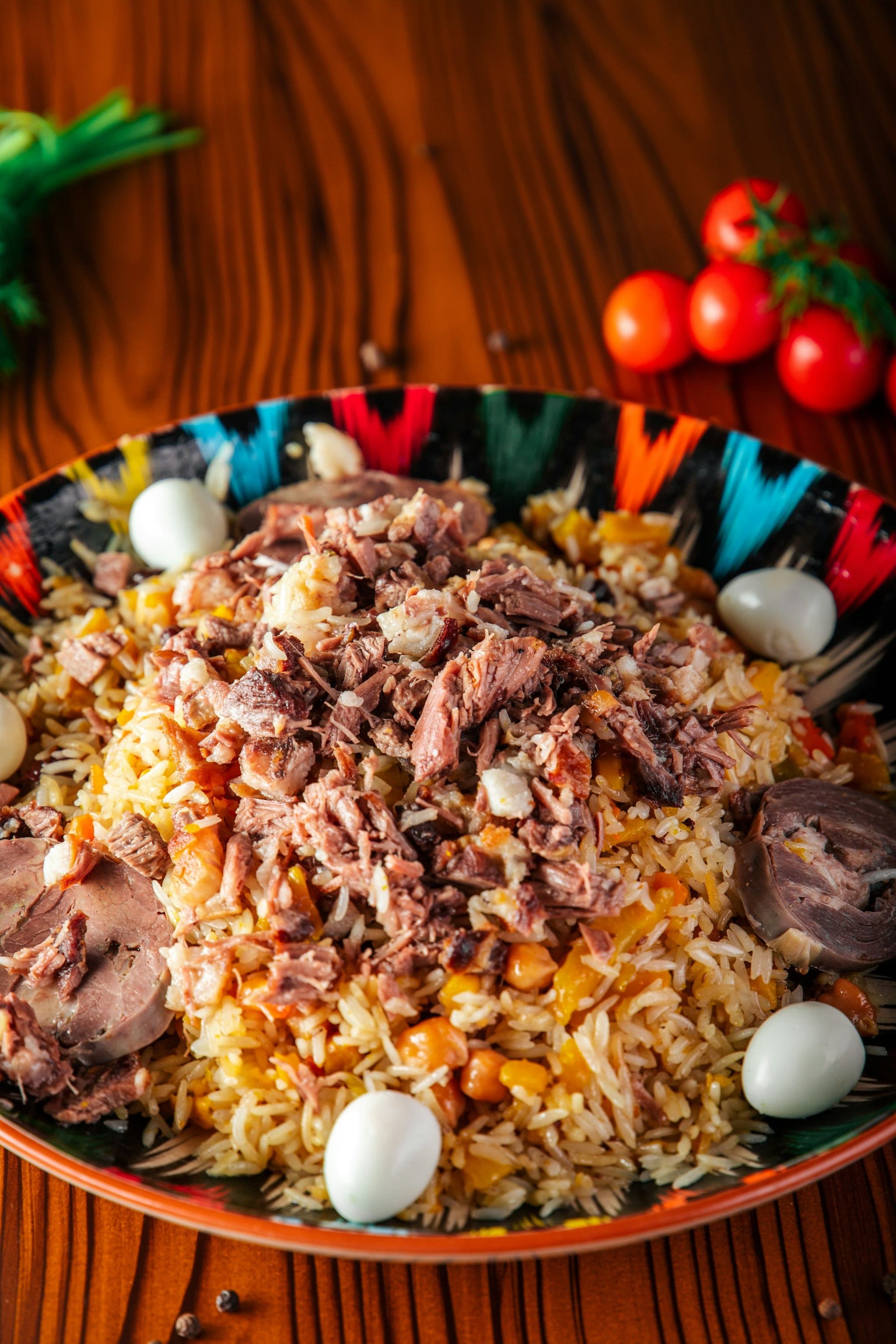
Is plov really worth planning a day around? Yes. UNESCO put it on its intangible heritage list in 2016, and it sets the tone for a cuisine built on rice, mutton, bread and tea. Pork is rare and nearly everything is halal. Vegetarians can lean on pumpkin somsa, but check what the soups are made with.
Plov, the national dish
Plov, or osh, is rice cooked in a kazan with mutton and yellow carrots, and an oshpaz is the master cook who makes it. It's served on a shared lagan platter. At weddings there's a morning plov, nahor oshi, served at dawn. Eat it at lunch, because by mid-afternoon the good places have often run out.
Non, the bread you never cut
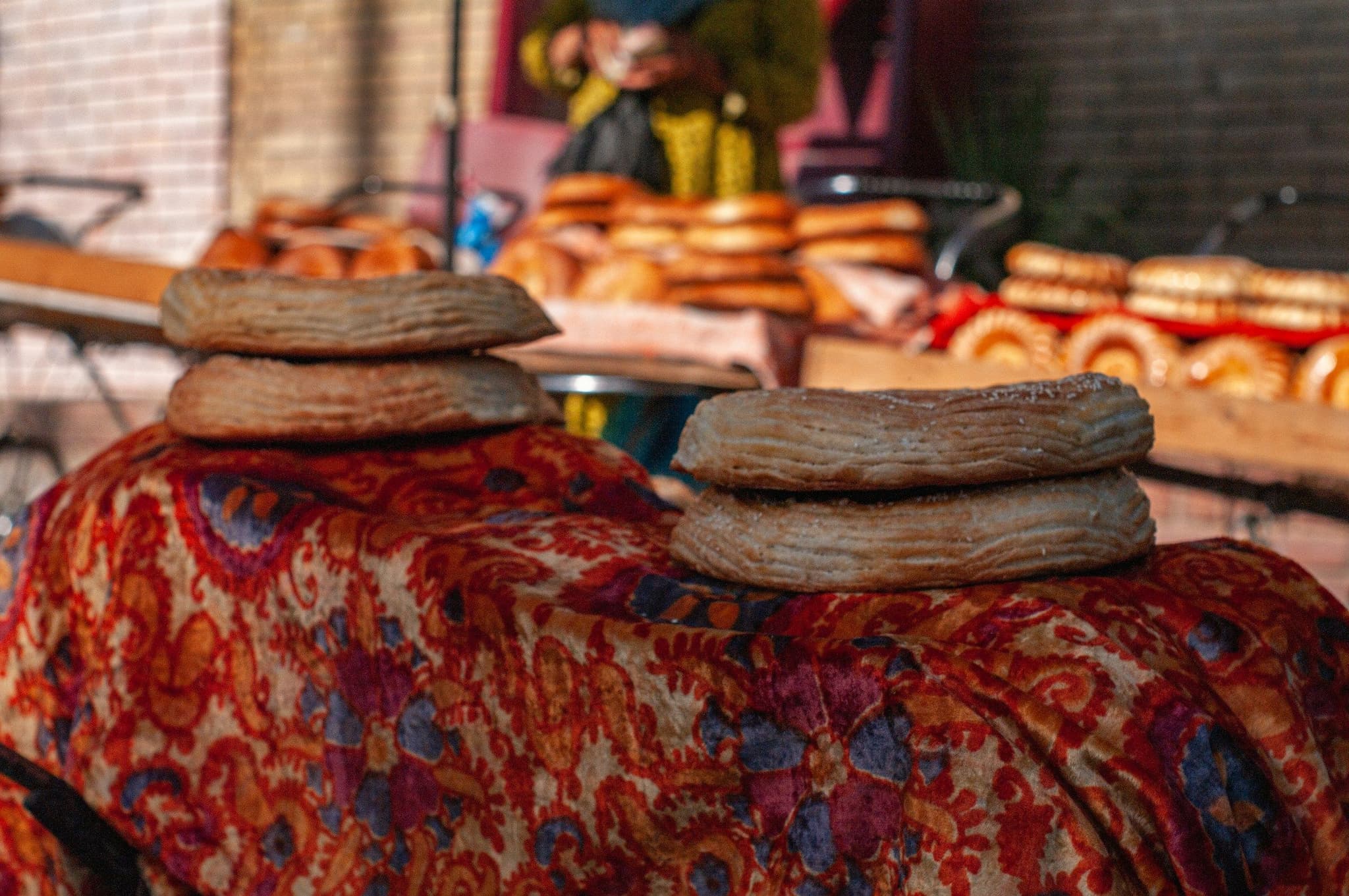
Non is a round flatbread baked in a tandir oven, with a stamped pattern in the middle, and Samarkand's version is the famous one. Tear it by hand, never cut it, and never put it upside down or on the ground.
Somsa, the pastry to eat hot
Somsa is a baked pastry filled with lamb, pumpkin or potato. Eat it hot, and try the pumpkin one at least once.
Green tea in a choyxona
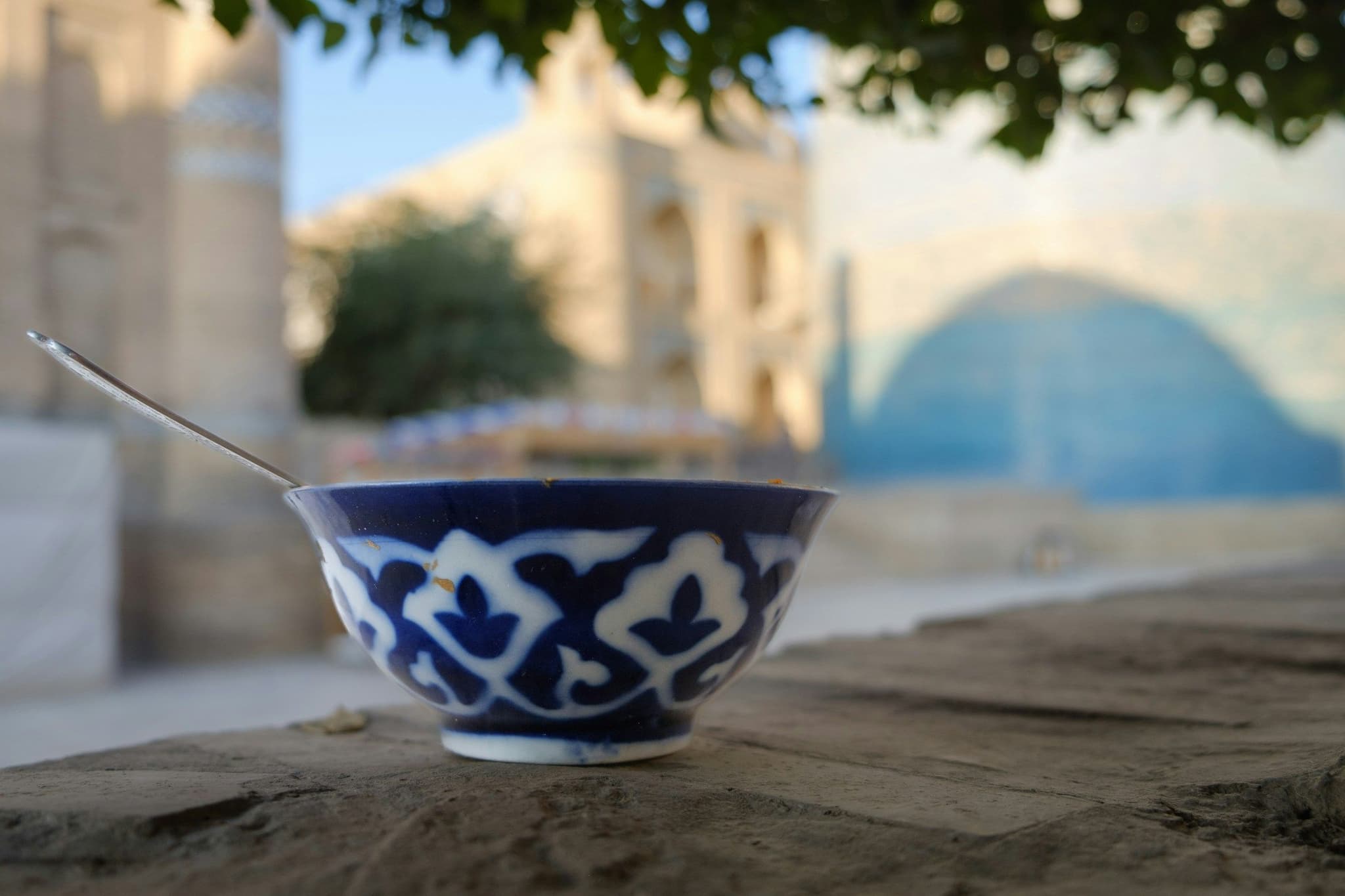
Green tea, kok choy, is poured into a piyola bowl at the choyxona, the teahouse. Your host pours it back into the pot three times to brew, and a guest gets a half-filled bowl so it can be topped up often.
Culture and local habits you'll notice when visiting Uzbekistan
About 94 to 96% of Uzbeks are Muslim, mostly Sunni, yet the constitution is secular, and you'll notice that balance quickly. The countryside and the Fergana Valley are more conservative than Tashkent. Men greet with a handshake, often with the right hand on the heart, and you shouldn't offer your hand to a woman unless she offers hers. Take your shoes off in homes and mosques, and bring a small gift if you're invited home. Life revolves around the mahalla, the self-governing neighbourhood at the centre of weddings and funerals.
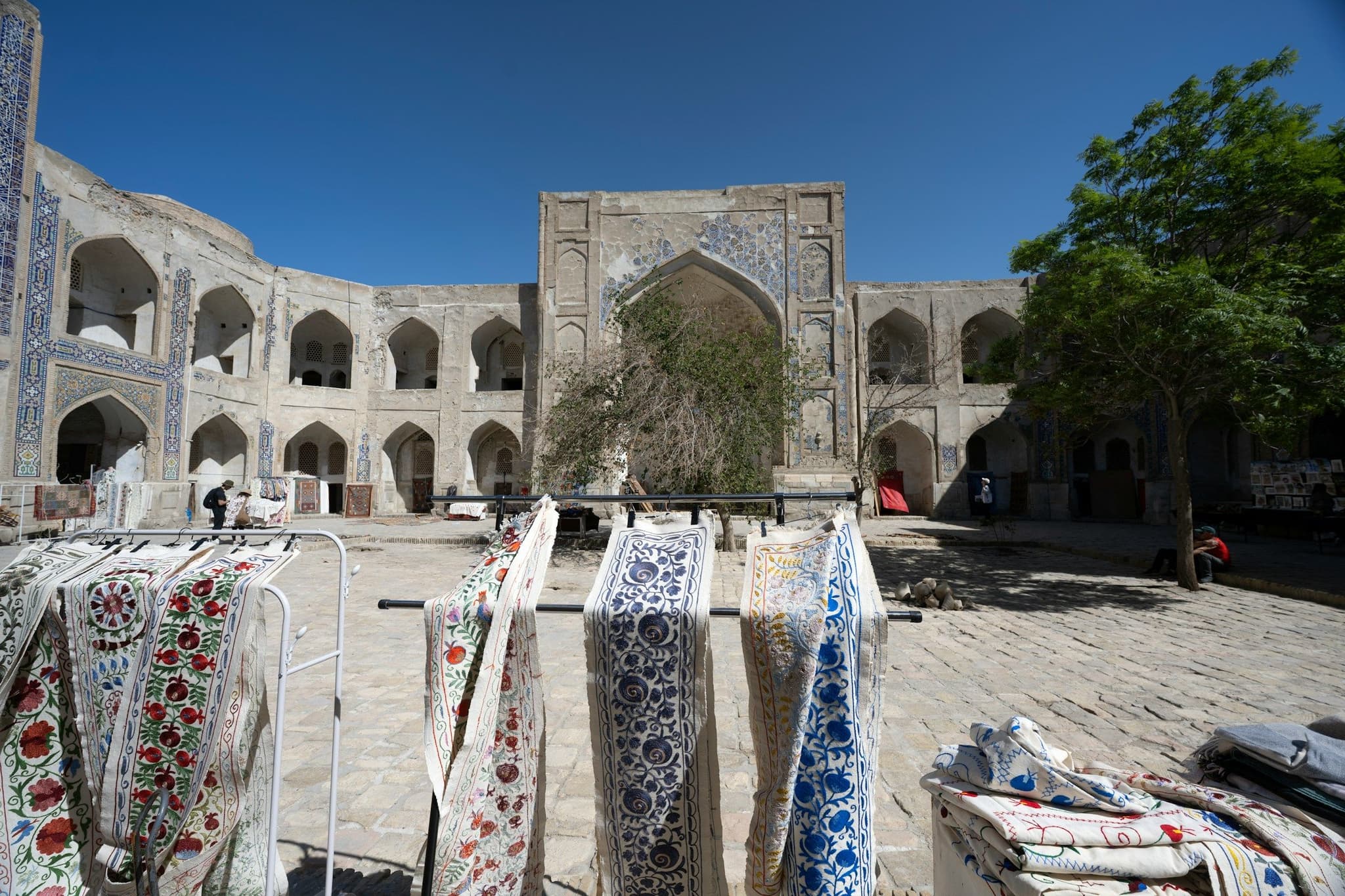
Language is more mixed than most visitors expect. Uzbek has used a Latin alphabet since 1993, but Cyrillic signs are still everywhere, Russian is widely spoken, and Samarkand and Bukhara are mainly Tajik-speaking. Ask before you photograph people, and keep the camera away from military sites and government buildings. The crafts are what we'd spend money on, especially suzani embroidery and Margilan ikat.
Looking for more unique places, trips and activities?
Subscribe to our Guided Newsletter for more travel inspiration.
Costs of a holiday to Uzbekistan
For what you get, we think Uzbekistan is among the best-value countries in Central Asia. Numbeo's 2026 mid-year index puts its cost of living at 28.6 (New York = 100), 132nd of 152 countries when ranked from most to least expensive. That's close to Kyrgyzstan at 27.6 and Tajikistan at 28.0, and clearly below Kazakhstan at 32.7 and Turkey at 40.2. Train fares rose 15% in February 2026 and entry tickets have climbed too, so ignore prices in older guides.
Food & Drink

Coffee
UZS 20,000 – UZS 35,000
Lunch
UZS 40,000 – UZS 100,000
Beer
UZS 15,000 – UZS 35,000
Accommodation

Hotels
UZS 450,000 – UZS 1,100,000
Guesthouse
UZS 250,000 – UZS 500,000
Hostel dorm
UZS 90,000 – UZS 180,000
Transport

Trains
UZS 311,000 – UZS 509,000
Public Transport
UZS 2,500 – UZS 3,000
Car Rental
UZS 400,000 – UZS 500,000
Attractions

Museums
UZS 30,000 – UZS 60,000
Big Attractions
UZS 100,000 – UZS 250,000
Theatre
UZS 30,000 – UZS 150,000
Practical tips for visiting Uzbekistan
What should you sort out before you land? Two things, the three-day registration and enough cash, because ATMs are scarce outside the cities.
✔ Check the visa-free rules and register within three days
Many nationalities, including the UK, EU and US, can visit for up to 30 days without a visa. US citizens joined the list on 1 January 2026. Others can get a US$20 e-visa at e-visa.gov.uz, applying at least three days ahead. Your passport should be valid for three months after arrival. You must be registered within three days, weekends included, which hotels do for you, and missing it can mean fines or deportation. Check the rules for your own passport on the UK Foreign Office entry requirements page or the US State Department site before you go.
✔ Bring clean US dollars and expect to use cash
You can only get so'm (UZS) inside Uzbekistan. Visa and Mastercard work in hotels and supermarkets and for train and air tickets, but not in bazaars or small cafés. ATMs that take foreign cards are scarce outside the main cities. Bring undamaged US dollar notes printed in 2013 or later, change them only at official booths, as the black market is illegal, and expect a 10 to 15% service charge in many restaurants. Since April 2026 you need a card to buy alcohol in shops, and fuel is card-only too.
✔ Book trains early and use licensed taxis
Book fast trains as soon as sales open in spring and autumn. On night trains, the FCDO advises locking your compartment. Use Yandex Go or MyTaxi rather than flagging down unmarked cars, and expect that many taxis have no rear seatbelts.
✔ Watch your bag in the bazaars
The US State Department rates Uzbekistan Level 1, exercise normal precautions, and calls it generally a safe destination. Pickpocketing and bag-snatching are the main risks, in bazaars and on public transport. Avoid demonstrations. Take care near the Afghan border, where the FCDO advises caution and says many sites need local permission or an organised tour. Stay in Termez city and book a local guide for anything near the river.
✔ Plan around the heat and drink bottled water
Tap water isn't safe, so drink bottled or filtered. Summer highs of 35 to 37 °C are normal. In winter, Tashkent's air quality can be poor. Buy insurance that covers medical evacuation, and dial 103 for an ambulance.
✔ Carry your passport and know the local laws
Police can check your passport at any time, so carry it. Same-sex relationships are illegal, and public affection is best avoided. Don't photograph government buildings or military sites, and think twice before posting about public buildings or the government on social media. Drones need a permit, and a local SIM needs your passport and an IMEI registration for your phone.
Fun facts about Uzbekistan
Our favourite is the first one, and it makes a good pub-quiz question.
- Uzbekistan is one of only two doubly landlocked countries in the world, along with Liechtenstein.
- Ulugh Beg's star catalogue, published in Samarkand in 1438 to 1439, listed 1,019 stars and wasn't bettered for accuracy until the 16th century.
- Khorezm's Lazgi dance has been on UNESCO's intangible heritage list since 2019.
- Photography was banned in the Tashkent metro from its opening in 1977 until 2018.
- Uzbekistan's 2026 census was its first since 1989 and counted about 39 million people.
- Tashkent's modernist buildings became the country's eighth World Heritage site in 2026.
If you can only fit two stops, make them Samarkand and a night inside Khiva's walls.
Ready to map out your trip to Uzbekistan?
We hope this Uzbekistan travel guide has given you a clear starting point for your trip. Stay tuned for more inspiration, itineraries and practical tips to help you shape your perfect holiday to Uzbekistan. And don't forget to check out our Guided app, where you can create your own trip or use trips shared by other travellers for free.
FAQS about visiting Uzbekistan
How many days do you need in Uzbekistan?
Five to seven days covers Tashkent, Samarkand and Bukhara, and a night in Khiva fits if you have the full seven and the high-speed train runs on the right day. With 10 to 14 days you can add the Fergana Valley, a yurt camp, the desert fortresses and Nukus. In the Guided app, you can create your own route and see how many places fit into your days.
What is the best part of Uzbekistan to visit?
Samarkand, for the Registan and Shah-i-Zinda. Bukhara is the better city to linger in, and Khiva is the one complete walled town. For crafts, go to the Fergana Valley.
What is Uzbekistan known for?
Its blue-tiled Silk Road cities come first. It's also known for plov and Margilan silk, and the shrinking of the Aral Sea.
Can you travel around Uzbekistan without a car?
Yes. High-speed trains link Tashkent, Samarkand, Bukhara and Khiva, and domestic flights reach Nukus and Termez. For Shakhrisabz or the desert fortresses, hire a car with a driver for the day.
Is Uzbekistan expensive for a holiday?
No. Numbeo's 2026 index puts it below Kazakhstan and Turkey, and on a par with Kyrgyzstan. Trains and entry tickets are the biggest costs, and both have gone up recently.
Is Uzbekistan safe to visit?
The US State Department rates it Level 1, its lowest advisory level. Pickpocketing in bazaars and unlicensed taxis are the main everyday risks. Same-sex relationships are illegal, so LGBT+ travellers should be discreet.
Do I need a visa for Uzbekistan?
Many nationalities, including the UK, EU and US, can stay up to 30 days without a visa, and others can apply for an e-visa at e-visa.gov.uz. Whatever your passport, you must be registered within three days of arrival, which hotels and guesthouses do for you.
When is the best time to visit Uzbekistan?
April to May and September to October, when daytime highs sit around 22 °C. Summer regularly passes 35 °C, and winter is quiet but cold, especially in Khiva.
Plan your trip to Uzbekistan in Guided.
Save the places you find, then let Guided lay out the days, the map and the details.
More in Asia
All destinations ChinaChina packs imperial Beijing, the Terracotta Army, misty karst rivers and some of the world's best regional food into one vast country linked by fast trains.
 IndiaIndia is a vast and diverse country celebrated for its rich history, spiritual traditions, unique food and stunning landscapes ranging from the Himalayas to tropical coastlines.
 IndonesiaIndonesia is a tropical paradise of islands with stunning beaches, breathtaking natural beauty, and rich cultural history.
 JapanJapan offers a blend of ancient traditions and cutting-edge technology, stunning natural landscapes, and globally influential culture.